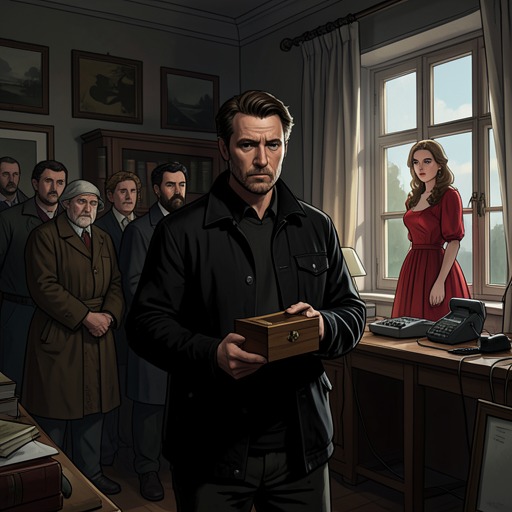
Doc Trades Heroin for His Friends’ Safety
Inherent ViceDoc’s heroin exchange with the Golden Fang’s representatives becomes a bargain for people rather than money: he accepts the return of the drugs only after seeking protection for those close to him and an end to Coy Harlingen’s undercover obligations. The transaction reunites Coy with a life outside the organizations that employed him, while leaving Doc’s confidence in the promise of safety deliberately uncertain.
The bargain shifts from property to people
Crocker Fenway opens negotiations by offering Doc a generous compensation package for the safe return of the Golden Fang’s property. Doc asks whether the compensation must take the form of money. Crocker says money would be easier, but Doc makes clear that his concern is the safety of people around him. The exchange is thus not simply an attempt to profit from the heroin: Doc uses his leverage over the drugs to seek assurances about the lives and freedom of others.
Doc identifies friends and family, then singles out Coy, a saxophone player who has worked undercover for several antisubversive organizations, including the LAPD. Coy has come to believe the career choice was wrong; Doc explains that it cost him both his family and his freedom. He invokes Coy’s young daughter in making the case, a detail that brings the personal cost of the arrangement into a negotiation otherwise framed around property and compensation.
Coy’s release and its conditions
Doc says Coy wants out, and that he believes he can settle the matter with law enforcement. Vigilant California is the remaining obstacle. Crocker describes the organization’s members as useful in the street but politically unsophisticated, and recognizes that they would not want Coy to disclose confidential information. Doc replies that Coy would not do so and gives Crocker a personal guarantee: if Coy tries, Doc himself will pursue him.
Crocker agrees that, barring surprises, an amicable separation can be arranged. The agreement is conditional rather than a promise of unconditional security: Crocker’s principals are concerned with whether the people in question pose a threat, while Doc offers his own assurance about Coy’s silence. The negotiation’s central trade is therefore specific. Doc is not asking to be paid; he is seeking the release of people whose safety and freedom are entangled with the machinery behind the heroin.
The handoff in Hawthorne
The terms are put into practice at a parking lot at the May Company shopping mall, at Hawthorne and Artesia, the following evening. The heroin is to be transferred only after verification that certain people have been allowed to go their ways unmolested; future guarantees of personal safety are not to be unreasonably withheld. Doc warns Crocker that his reputation as a fixer is at stake and that a deception would have consequences. Crocker protests at the suggestion of revenge, but the exchange proceeds on Doc’s insistence that the human terms come first.
Doc arrives with Denis, who recognizes the heroin as smack and doubts that Doc is making money from the trip. Doc explains that what he is getting is the other side’s word that they will not hurt anyone: his friends, his family, Denis, and himself. When Denis questions whether such a promise can be trusted, Doc rejects the idea that trust belongs only to good people. People he calls good are bought and sold every day; trusting someone evil is, in his view, no more or less certain. His answer does not resolve the danger. It establishes the risk he is choosing to accept in order to secure the bargain.
The Golden Fang’s unlikely emissaries
The representatives appear not as a conventional criminal crew but as a blond California family in a 1953 Buick Estate Wagon. The wagon’s nostalgic suburban image contrasts with the illicit cargo and the coercive reach implied by the negotiation. Its parents handle the business; the children remain in the car, giving the staged family appearance a carefully ordinary surface. Doc opens the trunk, and the father takes charge of the drugs.
The mother gives Doc a flat plastic object. At first he does not understand why she is handing it to him, but he sees Coy Harlingen’s name on it: a bank card issued in Coy’s name. The father tells Doc to pass on a welcome back to the main herd and wishes him safe journeys. Denis writes down the message, preserving the formal words of Coy’s reintegration even as the people who deliver them are operating on behalf of the Golden Fang.
Release, return, and unresolved pursuit
After the Buick leaves toward Hawthorne Boulevard, Doc sees a battered El Camino following it. The car can only be Bigfoot Bjornsen’s, and its pursuit keeps the heroin transaction connected to the unresolved investigation into the Golden Fang and the killing of Bigfoot’s partner. Doc wonders where the tail will lead Bigfoot, and whether following the twenty kilos will bring him closer to the questions he wants answered: who hired Adrian Prussia to kill his partner, how Adrian connects to Crocker’s principals, and whether the Golden Fang exists in the form Bigfoot suspects. The exchange wins a measure of safety for Coy and others, but it does not close the larger network of violence and suspicion surrounding the drugs.
Coy later reports that he is officially off everyone’s payroll, after Burke Stodger calls him personally to confirm it. The release is confirmed not merely by the card but by the end of Coy’s employment. He is back in contact with family and speaking about a concert he played, including solos on “Steamer Lane,” “Hair Ball,” and a Dick Dale salute. The change gives the transaction a human outcome beyond the transfer of property: the undercover musician is no longer bound to the organizations that separated him from his family and freedom. Doc’s bargain has produced a concrete release, though its wider promise of safety remains subject to the unresolved forces still following the heroin.